
Reading a Custom Jewelry Factory's Manufacturing Steps
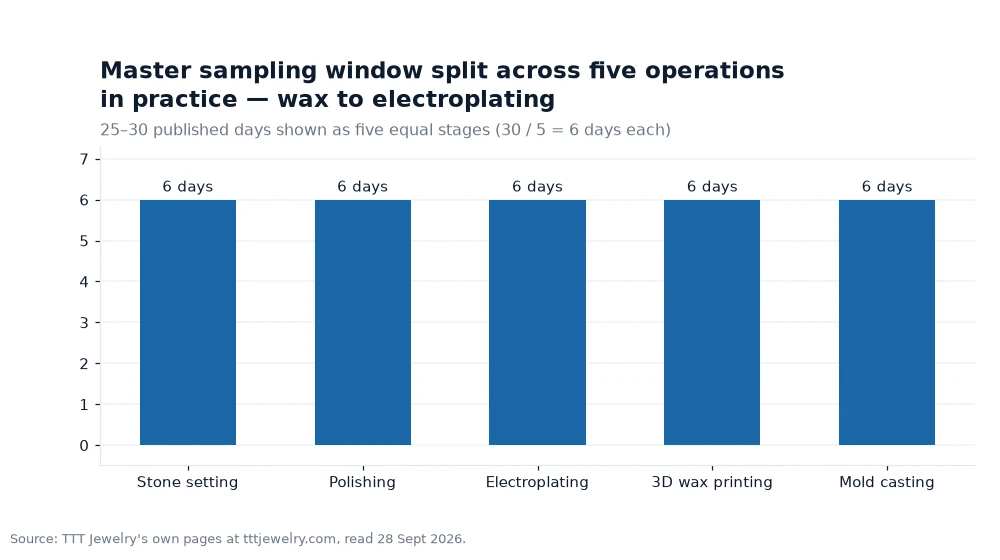
A factory's step list looks like marketing until you notice that each stage consumes a different input and produces a different kind of risk. TTT Jewelry publishes eight: concept design, prototyping, sprue cutting, polishing, surface art, electroplating, final QC and delivery. The same site quotes 25–30 days for a master sample, which works out at roughly 6 days per bench operation across five of those stages.
Key takeaways
- Eight published stages, each with its own input, failure mode and inspection point.
- A 25–30 day sampling window spread over five bench operations averages about 6 days each.
- Electroplating cannot fix porosity; it reveals it, which is why QC sits after plating rather than before.
- 100% inspection means every piece passes the gate, not a sample drawn from the batch.
A process list is a set of handoffs
Most buyers read a step list as a sequence of activities. It is more useful to read it as a sequence of handoffs, because that is where orders lose time. Each stage hands a physical object to the next stage, and each handoff has a condition that must be met for the next step to work. Wax must be sound before casting. Castings must be clean before polishing. A polished surface must be degreased before plating.
Reading the list this way changes the questions a buyer asks. Instead of "how fast can you make it", the question becomes "what does the previous step have to guarantee before this one starts". That framing also explains why a factory that publishes its steps is easier to audit than one that publishes only a lead time: a lead time is an outcome, while a step list is a set of checkpoints.
Read this way, the list doubles as a due-diligence tool. A B2B jewelry manufacturing partner that can name the owner of each handoff is describing a system; one that names only activities is describing a brochure. In an OEM/ODM project the brief and the model are the two documents that carry design intent from concept to bench, and both have an owner.
The published route begins with concept design, hand-drawn and CAD, then prototyping by mould or 3D printing. Those two stages decide nearly everything downstream. A wall thickness chosen at concept stage determines whether the casting fills. A sprue position chosen at prototyping decides how much metal is cut away and how much finishing the piece will need.
Prototype, then cut the sprue
Prototyping is where the design stops being a drawing and acquires a weight, a surface and a shrinkage factor. Mould-based prototyping suits shapes that will repeat; 3D printing suits shapes that will be revised. Either way, the prototype is the object a buyer approves, and approval should be recorded against a specific version rather than a date.
Sprue cutting is the least discussed and most physical step. Cast metal arrives attached to a feed system, and cutting it away leaves a scar that polishing has to remove without altering the profile. A sprue placed on a visible face costs polishing time; a sprue placed too close to a thin section risks distorting it during removal. Buyers rarely see this step, and it is one of the main reasons two factories quote differently for the same drawing.
Polishing and surface art
High-gloss polishing precedes texture, not the other way round. A brushed or textured surface applied over a poorly polished base keeps the scratches, because texture hides small defects rather than removing them. The published sequence puts polishing before surface art for that reason: the surface is brought to a clean state, then deliberately interrupted.
This is also where a buyer's finish language gets tested. "Matte" can mean sandblasted, brushed in one direction, or chemically etched, and each produces a different wear pattern. Naming the process rather than the appearance is the only way to repeat it on a reorder. The same applies to mixed finishes on a single piece: the boundary between polished and brushed areas needs to be specified as a line on the drawing, not a verbal description.
Electroplating, and what it cannot hide
Plating is a coating, not a filler. Multi-layer 14K, 18K or 24K gold and rhodium are applied over a prepared substrate, and every layer follows the surface beneath it. A pit in the casting becomes a pit under the gold. A polishing scratch becomes a line under the rhodium. This is why plating sits late in the sequence and why final inspection follows it.
Substrate determines the plating route. Silver and brass take an anti-tarnish e-coating to slow oxidation. Stainless takes PVD vacuum plating, which bonds differently and suits 316L particularly well because of its 2–3% molybdenum content. Published compliance covers REACH and CA Prop 65 for plating, which matters because a coating is the layer in contact with skin.
| Stage | Input condition | Defect if rushed |
|---|---|---|
| Prototyping | Approved CAD with tolerances | Shrinkage not allowed for |
| Sprue cutting | Sound casting, marked feed points | Scar on a visible face |
| Polishing | Clean, degreased casting | Scratches sealed under texture |
| Surface art | Uniform high-gloss base | Uneven brushed grain |
| Electroplating | Prepared, pit-free surface | Pits and lines visible through plating |
| Final QC | Plated, assembled piece | Faults shipped and returned |
The last handoff. The published final QC is 100% inspected, which is a different claim from sampling. Sampling estimates a defect rate; 100% inspection removes individual defects before they leave. The distinction matters at the point where a plating fault would otherwise reach a retail shelf and come back as a complaint about tarnish.
Inspection also closes the loop on documentation. A piece checked against an approved sample, a plating specification and a packaging list produces a record. Without that record, a reorder is a reconstruction rather than a repetition, and reconstruction is where specifications drift.
Worked example
Take the published 25–30 day sampling window and divide it across five bench operations: mould casting, 3D wax printing, stone setting, polishing and electroplating. At 30 days that averages 30 ÷ 5 = 6 days per operation. At 25 days it is 5 days each. The window is not a queue of independent tasks; several overlap, which is why the per-operation figure is an average rather than a schedule.
Set the CAD stage against it. Modelling takes under 48 hours, which is 2 days. As a share of the sampling window that is 2 ÷ 30 = 6.7%, or 2 ÷ 25 = 8%. The modelling step is short enough that a single avoidable revision costs proportionally more than the original work.
Then add bulk. Two days of CAD, 25–30 days of sampling and 21–28 days of production come to 48–60 days, or approximately 7–9 weeks. Spread across eight stages, that is roughly six to seven and a half days per stage if the work were perfectly sequential — which it is not, and that overlap is the only reason the total is not much longer.
Frequently asked questions
How many production steps does a typical order pass through?
TTT Jewelry publishes eight: concept design, prototyping, sprue cutting, polishing, surface art, electroplating, final QC and delivery. The bench stages between casting and plating are where most finish variation is decided.
Why does polishing come before texturing?
Texture sits on top of the base surface. Polishing first removes scratches and pits; texturing afterwards interrupts a clean surface deliberately. Reversing the order traps defects under the texture.
What does 100% inspection cover?
Every finished piece is checked against the approved sample, plating specification and packaging list. It is not a sample-based estimate of the batch defect rate.
What a step list tells you before the first order
A factory that can describe its own handoffs is usually a factory that can explain a delay. That is a practical advantage when a launch date is fixed and a plating batch needs re-running.
Reading the eight stages also gives a brand a checklist for the first factory call: which stage owns the tolerance, which stage owns the finish, and which stage signs off. If the answers blur, the process is being managed by memory rather than by route.
The same reading helps when a collection changes substrate. A shape proven in custom brass jewelry will need a different plating route in silver, and a piece moved to a sterling silver jewelry manufacturer line inherits a different polishing behaviour. The steps stay the same; the parameters inside them do not.
Source note: figures come from the manufacturer's own website (tttjewelry.com), read 28 Sept 2026.[1]