
Sampling Terms a Seasonal Fragrance Contract Should Fix in Writing
The sampling phase decides most of what a seasonal fragrance launch will cost and when it will ship, yet it is usually the least specific part of the paperwork. Before signing, settle six things in writing: how many revision rounds are included, what counts as a revision rather than a new brief, what the sample fee is and whether it is credited, who judges the sample and against what, how the approved standard is retained, and how long each round is expected to take.
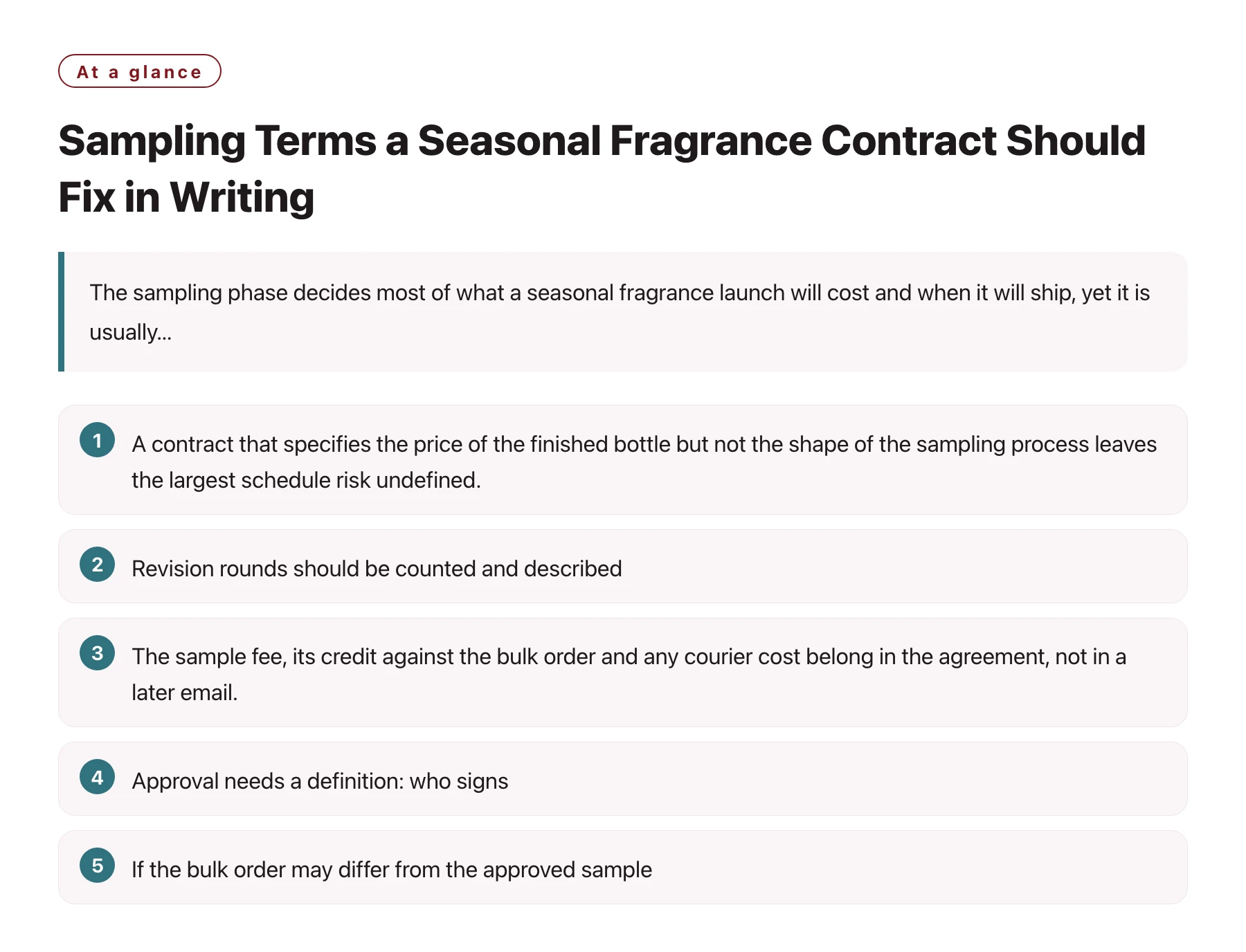
Key takeawaysA contract that specifies the price of the finished bottle but not the shape of the sampling process leaves the largest schedule risk undefined. · Revision rounds should be counted and described, because the difference between a tweak and a new direction is normally where timelines disappear. · The sample fee, its credit against the bulk order and any courier cost belong in the agreement, not in a later email. · Approval needs a definition: who signs, on what substrate, on which day, and what the retained standard is made of. · If the bulk order may differ from the approved sample, the acceptable direction and size of that difference should be stated before production starts. · A sampling schedule with named dates is a better predictor of a seasonal launch than any lead time quoted as a range.
Founders tend to negotiate the visible numbers: unit cost, minimum order quantity, decoration price, shipping terms. Sampling sits earlier in the chain and quietly controls all of them, because every extra round consumes weeks that a seasonal calendar does not have and often consumes materials that someone has to pay for.
The awkward part is that sampling is genuinely hard to specify in advance. Nobody knows how many attempts a brief needs. That is exactly why the terms should describe the process rather than predict the outcome: how many rounds are included, what triggers a charge, how approval is recorded, and what the supplier is obliged to match afterwards.
What follows is the set of terms worth settling before signature, framed as questions a brand founder can send to a supplier without needing a legal background.
How many rounds are included, and what starts a new one
Most suppliers include a small number of revision rounds in the development fee and charge for rounds beyond that. The number itself matters less than the definition attached to it. A round in which a perfumer adjusts dosage and one material is a revision. A round in which the direction changes from fresh floral to woody amber is a new development brief, and it is reasonable for a supplier to scope and price it separately.
Write both definitions into the agreement with examples from your own brief. This single clause prevents the most common dispute in fragrance development, where a brand believes it paid for five attempts and the supplier believes it delivered three revisions plus two new briefs. The distinction is also a useful way to read a partner: a factory that turns a brief into a scent normally describes development in exactly these terms, while a filling-only supplier may treat every adjustment as a new order.
What the fee covers and whether it comes back
A sampling fee normally covers the perfumer's time, the aroma materials and the filling of a small quantity. Ask what happens to that fee if the order proceeds, how much of it is credited, and whether it is credited against the first bulk invoice or spread across units. Also confirm who pays courier and duties on samples, because a seasonal project with five rounds across four formats can accumulate a surprising shipping bill.
If the fee is described as non-refundable in every case, that is a legitimate position. What is not workable is leaving the credit undefined until the bulk order is discussed.
Who judges the sample, and how
Approval is a decision, and a decision needs a method. Decide in advance whether the sample is judged on blotter, on skin, or both, how many people take part, and over what period. Fresh and citrus-heavy structures can read differently after an hour, and a formula evaluated only in the first ten minutes may be approved for a performance it does not have.
It also helps to agree how the sample is stored before it is tested. Light and heat move a formula over weeks, so two people testing the same sample at different times may not be testing the same thing.
What happens to the formula if you walk away
Rejected samples still contain work. A supplier may reuse a base or an accord developed during your brief for another client unless the agreement says otherwise. The opposite is also worth checking: if you paid for development and then take the project elsewhere, do you have any claim on the formula or the documentation?
Intellectual property in outsourced development turns on what the contract says, not on who paid the invoice. Ownership of a commissioned formula is normally decided by the terms the parties agree, which is why WIPO advises making ownership explicit in writing rather than relying on an assumption about who funded the work [1]. Ask for the sentence that transfers or withholds ownership, and read it before sampling begins rather than after a sample you like is in hand.
The practical middle ground many brands accept is exclusivity for a defined period, in defined markets, for defined formats. It is more affordable than outright assignment and it protects the launch window, which is usually the commercial risk a seasonal range actually carries.
Matching the bulk order to the sample
Approval is only useful if the bulk order has to match it. Settle how the approved standard is retained: a sealed sample, its compounding sheet, and a stored quantity large enough to compare against later batches. Agree how long it is kept and who holds a copy.
Agree the acceptable difference as well. Colour may shift slightly between batches, viscosity may move with temperature, and the smell immediately after filling is not the smell after resting. The everyday reasons why a sample and the bulk order can differ are resting time and raw material lot variation rather than a mistake, which is why the tolerance has to be described instead of assumed. If the contract says only 'must match the approved sample', it is describing an ideal rather than a specification, and the first dispute will be argued in adjectives.
Compliance is the second part of matching. A formula approved at sample stage still has to respect the use restrictions that apply to the product category it will be sold in, and those restrictions are published by material rather than by product name [2]. Confirm at briefing stage which category and which markets the range is intended for, so that a restriction is discovered before approval rather than after.
Timing each round so the season still works
A seasonal collection is a countdown. Write the sampling schedule backwards from the on-shelf date: decoration needs the approved fragrance and the final artwork, filling needs the decorated components, and shipping needs cleared documents. Every sampling round that overruns pushes the whole chain.
Rather than accepting 'samples in four to six weeks', ask for the number of working days from brief receipt to first submission, and from feedback to revised submission. Then agree how feedback is delivered, because a round only starts when the supplier has a complete, single set of comments. Feedback arriving in three separate emails over ten days is a schedule risk that nobody has priced.
Founders who want to see how a perfumery-oriented supplier describes this stage can read the process notes published on Xuelei's official site, where the development sequence is set out from brief to finished bottle. The useful test is not whether a supplier has a process on its website, but whether the same dates and definitions appear in your contract.
Send the sampling terms to the supplier as a short written list before the commercial negotiation starts. Suppliers who answer precisely are showing you how they handle a project; suppliers who wave the list away are showing you that too, while it is still free to change your mind.
Sources
- WIPO — World Intellectual Property Organization —— The UN agency for intellectual property; resources on industrial design and patent protection relevant to product and packaging design.
- IFRA: Safe Use and Fragrance Science —— IFRA's explanation of how fragrance materials are scientifically assessed for safe use and how those conclusions are applied by the industry.
Frequently asked questions
How many sample rounds should a seasonal fragrance project include?
Three rounds is a common starting point for a single format: a first submission, one adjusted version, and one confirmation. Ranges with several formats or an ambitious brief may need more, and the contract should say how those extra rounds are priced.
Is a sampling fee normal, and should it be refundable?
Yes, a fee is normal because aroma materials and perfumer time are real costs. Whether it is credited against the bulk order is a commercial choice, but the credit amount and the condition for receiving it should be written into the agreement rather than agreed verbally.
Should approval be based on a blotter or on skin?
Both, in sequence. Blotter testing is efficient for comparing directions, but skin changes how a formula opens and how long it lasts, so the final approval should include a skin test over several hours on at least two people.
What should happen to the formula if the project does not proceed?
The agreement should state whether the formula is assigned to the brand, retained by the supplier, or subject to an exclusivity period. Without a written position, the default depends on the terms in force, which is not a good position to discover after a launch is planned.
How do I avoid disagreements about whether the bulk order matches the sample?
Keep a sealed retained standard with its compounding sheet, agree how long it is stored and who holds it, and state what differences are acceptable in colour, clarity and odour profile before the bulk order is placed.